
One of the most common questions when travelling by camper is knowing exactly what you can and cannot do when you stop to sleep. The distinction between overnight parking and camping is not just conceptual: it has real legal consequences and varies by municipality, autonomous community and the type of land you are on.
Spain does not have a single national law that comprehensively regulates overnight camper parking. What exists is a general traffic framework, free-camping regulations managed by each autonomous community and a layer of municipal bylaws that can vary enormously from one town to the next. Understanding this framework helps you travel with more confidence and less uncertainty.
The key distinction: overnight parking vs camping
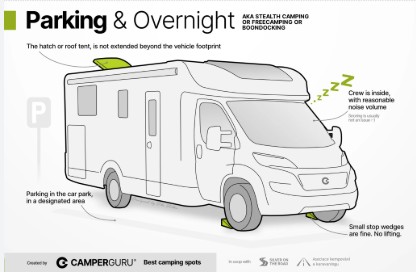
- Overnight parking means stationing your vehicle at night in a permitted location without deploying anything outside it. The vehicle functions as a self-contained, closed unit.
- Camping means deploying exterior elements: awning, table, chairs, outdoor rug, barbecue or any extension that occupies public or natural space outside the vehicle's footprint.
- In most Spanish municipalities, overnight parking in a motorhome is permitted wherever general parking is allowed, provided nothing is set up outside.
- Camping in a non-designated area, on the other hand, is generally prohibited and can result in an administrative fine.
The most useful practical rule
If everything is inside the vehicle or flush against it and you have not set up anything outside, in most places you are overnight parking, not camping. The moment you put out a chair, open an awning or place a table outside, you may already be breaking local regulations even if the ground is public land.
What Spanish regulations actually say
- The General Traffic Regulations allow habitable vehicles to park in permitted parking zones like any other vehicle.
- The Forests Act and protected natural area regulations specifically regulate free camping in forest and natural zones, with strict restrictions in many autonomous communities.
- The Coastal Act prohibits camping on public maritime-land domain and in the coastal protection zone near beaches.
- Each autonomous community also has its own free-camping legislation, and municipalities can restrict or prohibit even overnight parking within their boundaries through their own bylaws.
Where overnight parking is generally permitted
- In general public car parks where there is no specific sign prohibiting it.
- In designated motorhome areas, which have grown significantly in Spain in recent years.
- In campsites, which offer full services and complete legal security.
- On private property with the explicit permission of the owner.
- In some rural or forest areas where autonomous community regulations explicitly allow it, always without exterior deployment.
Where it is generally prohibited or heavily restricted
- Beaches and public maritime-land domain zones.
- Natural parks and protected areas in most autonomous communities.
- Urban areas of many municipalities that have passed specific motorhome bylaws.
- Forest zones during high fire risk periods.
- Motorway hard shoulders and rest areas beyond the maximum permitted time.
When in doubt, the useful question is not whether it is prohibited, but whether there is a sign or bylaw that explicitly permits it. In sensitive areas, the absence of a prohibition does not automatically mean permission.
Municipal variation: what changes from place to place
- Some coastal tourist municipalities have passed bylaws prohibiting motorhome overnight parking anywhere in the urban area, with fines of up to several hundred euros.
- Other municipalities, especially inland, have no specific restriction and treat it like any other parked vehicle.
- Provincial capitals tend to have stricter regulation and in some cases limited parking zones that make overnight stays impractical.
- The best way to find out before you arrive is to check the council website, look at Park4Night with recent comments or search in traveller groups with recent experience in that area.
How to handle an inspection or a warning from officers
- Stay calm and have the vehicle documentation and booking details accessible.
- If the officer asks you to move the vehicle, do so without arguing. It is not worth the confrontation.
- Ask for information about where you can go: local officers usually know the nearby alternatives.
- If you believe the fine is unjust, you can appeal it within the legal deadline shown on the penalty notice.
- Calm and respectful behaviour always helps to resolve the situation with less tension.
Practical summary for stress-free travel
Use designated areas whenever you can, especially in high-density tourist zones. Nothing outside the vehicle. Check Park4Night with the recent-comments filter before deciding where to sleep in unfamiliar areas. And if you have doubts about a specific municipality, the bylaw is usually published on the council website.
Useful resources
Frequently asked questions
Can I sleep on the street in my camper in any Spanish city?
It depends on the municipality. In many cities it is permitted if general parking is allowed and you do not set up anything outside. But more and more tourist municipalities have specific bylaws prohibiting or limiting it. Always check before you arrive.
Can I put a chair outside the camper without it counting as camping?
In most municipalities, deploying any element outside the vehicle already falls within the practical definition of camping. The exact legal line varies, but to travel without risk it is safer to keep everything inside or flush against the vehicle without occupying any exterior space.
What happens if I get an unfair fine?
You have the right to appeal the penalty within the deadline shown on the notice. Document the situation with photos if possible. If the offence was minor, in some cases paying with early payment reduces the amount by half.
Do paid motorhome areas offer complete legal security?
Yes. Officially designated areas are the option with the highest legal security. They also usually offer water, electricity and disposal services that make the stay more comfortable.
How do I find out if a beach or natural area has specific restrictions?
The council website, the natural park or the autonomous community usually publish the bylaw or usage regulations. Park4Night and camper traveller groups are also good sources with real, recent experience.
Travelling by camper with peace of mind is perfectly possible once you understand the basic legal framework and use tools like Park4Night to make informed decisions. Designated areas are always the safest option, but outside them there are still many possibilities if you act with common sense and keep everything inside the vehicle. Browse the available routes to find itineraries with recommended overnight areas included.